Your 2026 Reading Journal Canva Template: Design & Organize
A Digital Toolkit for the Modern Book Lover
There’s a specific kind of satisfaction that comes from tracking your reading life. It’s more than just a list of books; it’s a map of your intellectual journey, a collection of thoughts, and a celebration of stories that shaped your year. The 2026 Reading Journal Canva Template is designed to be the central hub for that journey. It’s not just a static PDF; it’s a fully editable Canva project, offering a clean, modern aesthetic that feels both personal and professional. The visual personality is one of organized calm—think ample white space, a balanced mix of clean sans-serif fonts for headings and readable serif fonts for body text, and a cohesive color palette that you can instantly customize to match your own brand or personal style.
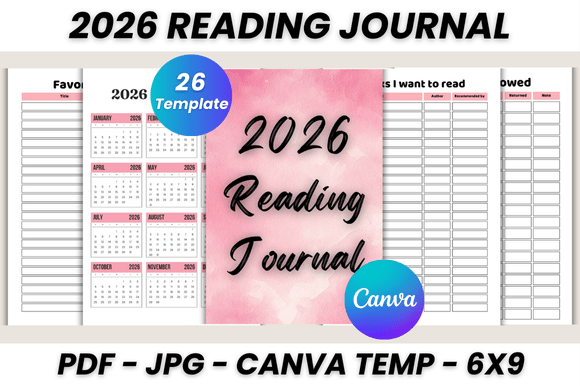
This template is built for real-world use. The 26 printable pages are thoughtfully structured, moving from the big-picture planning of a 2026 Calendar and Monthly Planner down to the granular details of individual Book Reviews and My Notes. It includes practical pages that acknowledge the social side of reading, like Books Borrowed and Books Lent Out, which are often overlooked in generic journals. The overall appeal lies in its flexibility; it serves as a personal reading log, a content creator’s editorial calendar for book reviews, or even a librarian’s or bookseller’s tracking tool. The design acts as a neutral yet elegant container for your content, ensuring your notes and reviews remain the focus.
Practical Applications Beyond Personal Use
While the primary use is personal, the professional applications of this editable Canva template are substantial. For bloggers, publishers, and content creators, it’s a ready-made editorial asset. You can use the monthly planner pages to schedule review posts, the Books I Want To Read list as a content pipeline, and the Book Review pages to draft and design graphics for your social media channels. The consistent visual language across all 26 pages ensures that any excerpt you share—from a favorite quote in the My Notes section to a full review—reinforces your brand identity. This is where the template transcends being a simple journal; it becomes a component of your professional design assets.
The design’s strength is its adaptability to different brand voices. By simply changing the colors and fonts in Canva, a minimalist bookstagrammer can maintain their serene feed, while a fantasy genre publisher can inject bold, thematic hues. The structure supports strong visual hierarchy, making it easy to guide a reader’s eye from a book title to a star rating, which is crucial for engagement in fast-scrolling digital environments. For entrepreneurs in the literary space, like indie authors or subscription box creators, this template can be repurposed into a customer-facing document—a beautifully designed yearly reading challenge guide or a curated reading list, adding a layer of professionalism that builds trust and recognition.
Customizing for Readability and Brand Perception
The true power of this template lies in its editable nature within Canva’s free version. You’re not just filling in blanks; you’re actively designing. The choice of typeface directly influences readability and the perceived personality of your journal. The default fonts likely strike a balance—a modern sans-serif for clear headings and a slightly warmer serif for body text to ease long-form reading. However, you have the freedom to experiment. Swapping the heading font to a bold, geometric typeface can give it a more contemporary, tech-forward feel, perfect for a blog focused on sci-fi. Introducing a subtle script or handwritten font for chapter titles or personal notes can add a layer of intimate, artisanal charm, ideal for a journal focused on classic literature or poetry.
This customization is key to influencing brand perception. A consistent font pairing across your journal and your other platforms—website, social media graphics, email newsletters—creates a cohesive brand identity that is instantly recognizable. The template’s layout is designed with readability in mind, using ample margins and logical spacing. When you edit, respecting these design fundamentals is crucial. Resist the urge to overcrowd pages. The included Notes pages are a blank canvas, but their effectiveness depends on maintaining that clean, breathable structure. The goal is to create a document that is not only beautiful but genuinely functional, whether it’s printed at 6x9 inches or viewed on a tablet.
Getting Started: From Download to Designed Journal
The process is straightforward, designed to get you from purchase to a customized journal with minimal friction. After purchasing, you receive a downloadable PDF containing the direct link to the Canva template, along with bonus JPG files. Clicking the link will prompt you to log into your free Canva account (or create one), and the entire 26-page template will load into your workspace, ready for editing. Every element is customizable: fonts, sizes, colors, layout components, and even the logo placeholder on the Belongs To page. You can resize the entire design to suit different printing needs, though the native 6x9 inch format is ideal for a personal, portable journal.
A practical recommendation is to start with the 2026 Calendar and Monthly Planner pages to establish your color scheme and primary font choices. This creates a foundation that you can then apply consistently across the more detailed pages like the Reading Tracker and Book Review sections. Think of this template not as a finished product, but as a professional-grade starting point. It provides the structure, the hierarchy, and the clean design principles, freeing you to focus on what matters most: the books, your thoughts, and the story of your reading year. It’s a tool that blends the utility of a planner with the creativity of a design project, resulting in a truly personalized literary companion.